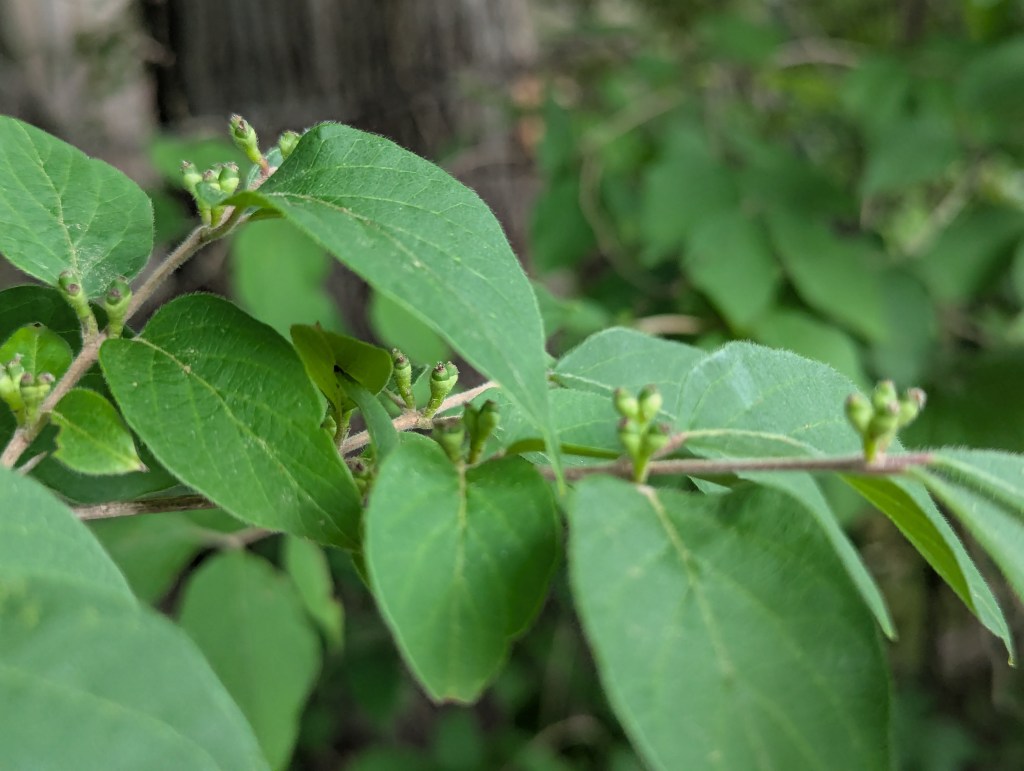
Bush honeysuckles are several invasive species in the same genus (Lonicera) that are abundant in Maryland’s habitats with unfortunate results:
- They outcompete native plants for soil moisture, light, and nutrients.
- Pollination, and therefore seed production, in native plants is reduced due to pollinators visiting bush honeysuckle flowers.
- One species in particular (Lonicera maackii) exudes chemicals that inhibit the growth of other plants and has been associated with higher populations of lone star ticks.
Originally from Asia and Russia, bush honeysuckles got their toehold here in the late 1800s when growers promoted them as ornamental shrubs. They were also used for decades to control erosion and to provide cover for wildlife.
Local Sightings
Photos taken Seen September 15, 2025 in the Philadelphia-Eastern Avenue Neighborhood (PEN). All photos are of Amur honeysuckle (Lonicera maackii), which seems to be the most prevalent bush honeysuckle species in the Takoma Park area.


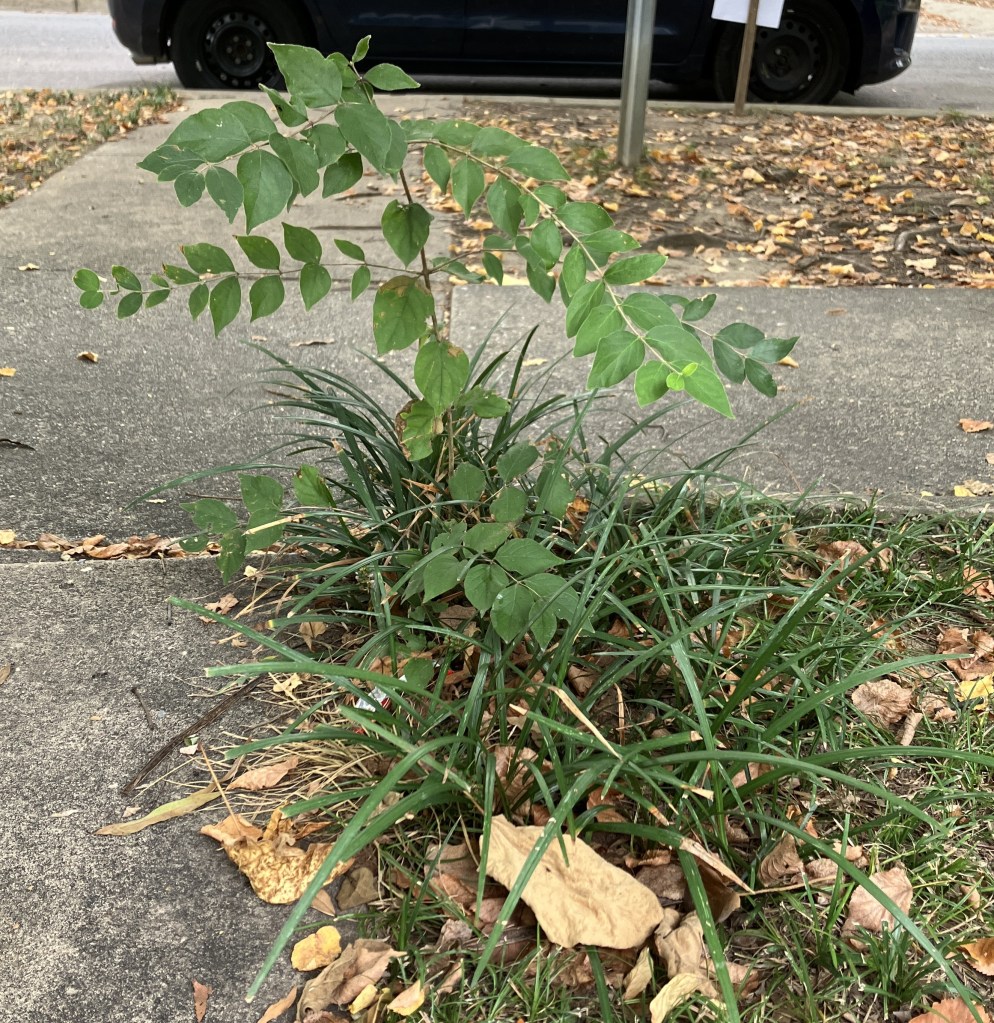

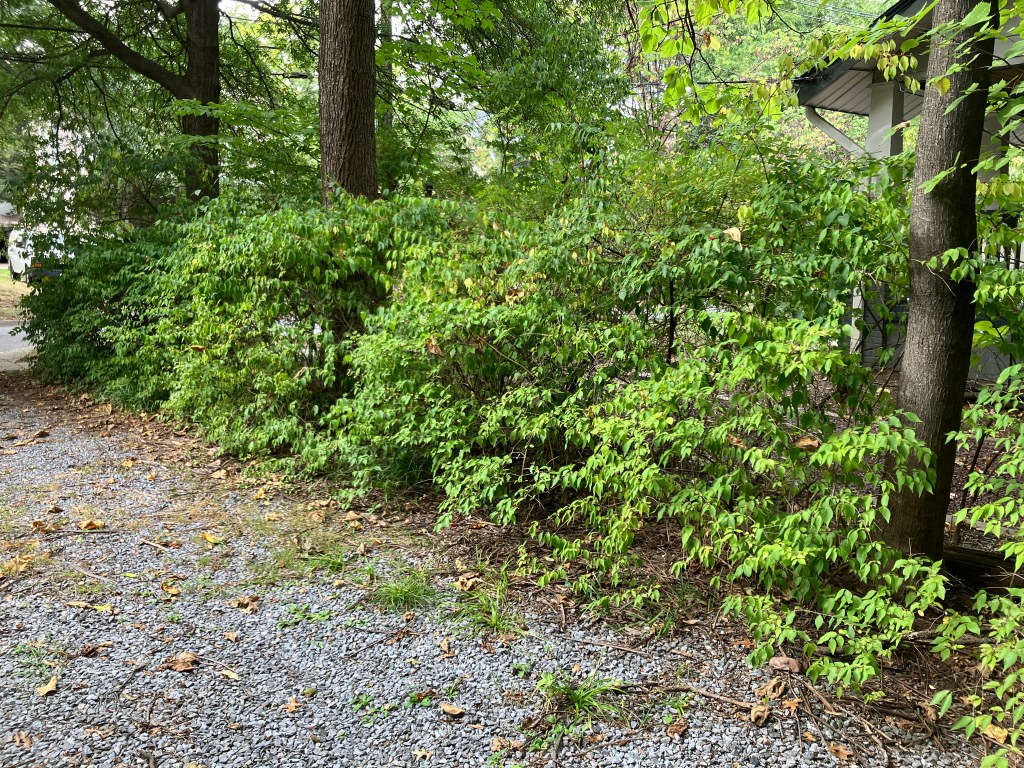


What to Look For
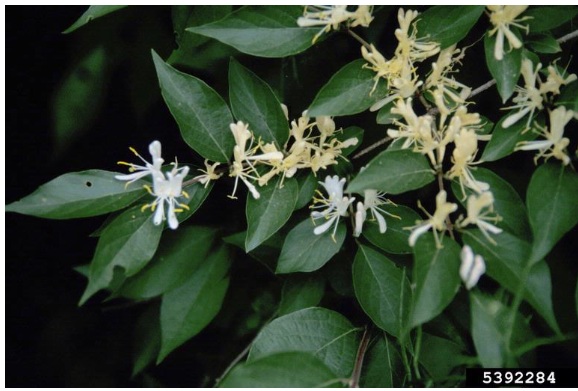
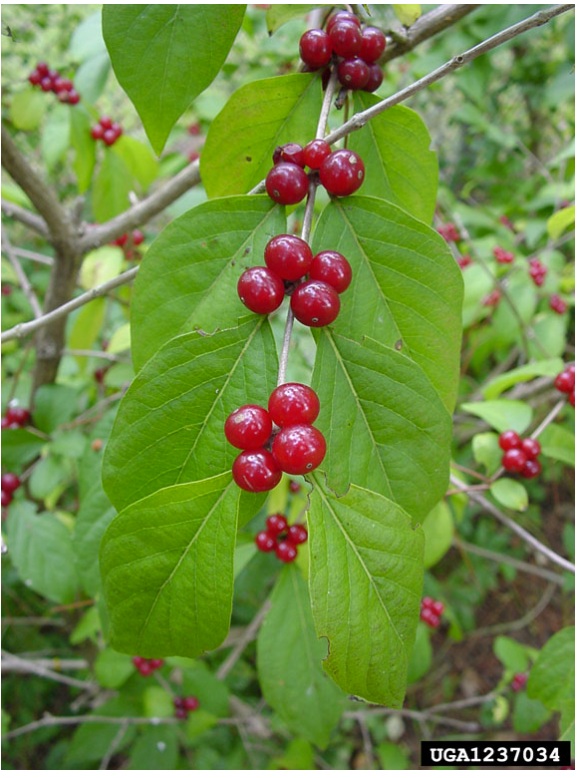
Bush honeysuckles are easiest to identify in spring by their flowers and in fall by their berries. Watch this video to learn more ways to identify bush honeysuckles.
All photos are of Amur honeysuckles (Lonicera maackii), as this species is the most common in the Takoma Park area,
Flowers

Berries and Leaves

Leaves


Stem
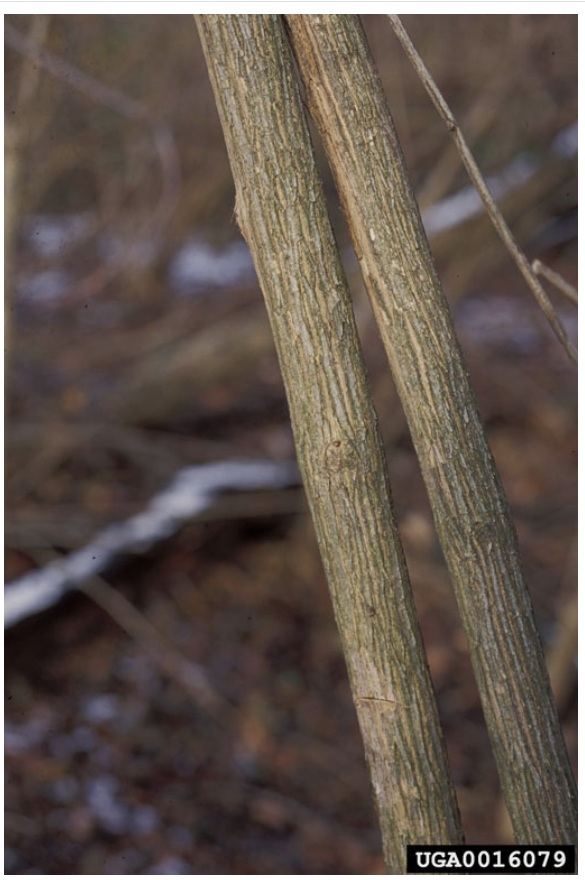

Hollow stems, together with the opposite leaves and red berries, is a reliable means to identify the invasive bush honeysuckles.
What to Do
The following advice comes from Michael S. Batcher, Global Invasive Species Team, The Nature Conservancy, BugwoodWiki.
Mechanical Control: Effective mechanical management requires a commitment to cut or pull plants at least once a year for a period of three to five years. Bush honeysuckles growing in more open settings can be managed by clipping twice yearly, once in early spring and again in late summer or early autumn. Winter clipping should be avoided as it encourages vigorous re-sprouting.
Herbicides: A survey of The Nature Conservancy land managers undertaken in 1998 found that most used glyphosate, and used it as a cut stump treatment, to control L. maackii and/or L. tatarica. All Nature Conservancy preserves reported that pulling is effective for smaller plants but is labor intensive. Cutting the shrubs was also effective, especially if the herbicide glyphosate is applied to the cut-stump immediately after cutting.
For cut stump treatments, 20-25% solutions of glyphosate or triclopyr can be applied (i.e., applied to the remaining stump after the plant has been cut down). 2% solutions of glyphosate or triclopyr can be used for foliar treatments (i.e., applied to the leaves without cutting down the plant). Both glyphosate and triclopyr should be applied to the foliage late in the growing season, and to the cut stumps from late summer through the dormant season.
What to Plant Instead
The following native shrubs can be used in place of bush honeysuckle.
Common witch-hazel (Hamamelis virginiana),
Winterberry (Ilex verticullata)
Arrowwood viburnum (Viburnum dentatum)
Blackhaw viburnum (Viburnum prunifolium)
Nannyberry (Viburnum lentago)
Red-twig dogwood (Cornus sericea)
Gray dogwood (Cornus racemosa)
Black chokeberry (Aronia melanocarpa)
Red chokeberry (Aronia arbutifolia)
Become inspired to take action by reading one resident’s reasons for hating bush honeysuckle.
For More Information
Maryland Biodiversity Project
Invasives in Your Woodland: Bush honeysuckles
Maryland Invasive Species Council: Amur, Morrow’s, and Tatarian Honeysuckles
Maryland Invasive Species Council: Japanese Barberry and Amur Honeysuckle
Penn State video on identifying bush honeysuckles
Exotic bush honeysuckles
BugwoodWik: Lonicera spp.
Assessment of nonnative bush honeysuckle in U.S. forests
Photo Credits: The photos with black and white numbered labels are from BugwoodWik.org, contributed by (in order of appearance) Chuck Bargeren, University of Georgia; Chris Evans, University of Illinois, John M. Randal, The Nature Conservancy; Anne Marie Smith, ODNR Division of Forestry; James H. Miller, USDA Forestry Service. The remaining photos are from various FONTT members.
 Friends of Native Trees in Takoma