The City of Takoma Park’s commitment to “focus on native trees” should mean a focus on Maryland native trees, as defined by the Maryland Plant Atlas.
Why the definition of “native trees” matters
In 2020, the City Council passed an urban forest policy and a revised urban forest ordinance, both of which stated that there should be a “focus on native trees” in planting.
In this context, defining “native tree” is good science and good public policy-making.
It’s good science because the discussion will bring out how plants, including trees, contribute to the sustainability of the ecosystem to which they are native. That in turn makes clear how trees and other plants native to an ecosystem can increase its biodiversity. The Council set increased biodiversity as a goal for the city’s urban forest.
It’s good policy-making because the definition will establish the pathway through which the strategy of focusing on native trees will achieve the goal of increased biodiversity.
Equally important, the definition of native trees will advance the discussion to a subsequent question, concerning when to plant non-native trees and which non-native species to select.
Why “native trees” should mean “Maryland native trees, as defined by the Maryland Plant Atlas.”
This webpage explains why FONTT argues for a focus on planting Maryland native trees by addressing three questions:
Why define “native” as native to Maryland?
Why define “Maryland native” based on the Maryland Plant Atlas?
Context of this discussion
FONTT presented comments to the City Council in July 2023 about the policy implications of recent changes to the city’s tree species list. The comments were organized around four questions, the first of which was “What is a native tree?”
FONTT subsequently decided that it would be more effective to discuss a single question at a time with councilmembers. This webpage presents the main points to be covered in discussing “What is a native tree?”
Why define “native” as native to Maryland?
Planting Maryland native trees is consistent with the City Council’s goal to increase biodiversity in our urban forest.
In 2020, the City Council decided that one goal in managing the city’s urban forest would be to increase biodiversity through planting native trees (Resolution 2020-15, pg. 2).
Biodiversity depends on relationships among species — myriad interactions among species of plants, animals, fungi, soil microorganisms, and other life forms — that have evolved over long periods of time in specific conditions. That location-specific network of vital relationships among species is an ecosystem.
To protect Maryland’s biodiversity means protecting Maryland’s ecosystems and the vital networks of relationships among the species native to those ecosystems. As relatively big native plants, native trees have evolved a large number of these vital interactions with other native species. In numerous Maryland ecosystems, native tree species have so many relationships with other species that the trees are considered keystones, or linchpins, of the ecosystems.
The greatest threat to Maryland’s native species comes not from climate change, although this is certainly one driver of biodiversity loss, but from development and the consequent the loss of habitat for native species of all types (FONTT 2023, pg. 4).
By favoring Maryland native trees, the Takoma Park urban forest will provide more of the food, shelter, and space to reproduce that other Maryland native species require to survive. In this way, the city’s urban forest can help mitigate the harmful effects on nature from development.
Maryland state policy stipulates planting Maryland native trees and other Maryland native plants whenever possible.
As a state, Maryland is recognized regionally and nationally as a leader in environmental legislation and programs. Therefore, the City of Takoma Park should consider state policies and practices in this respect, especially since the state has applied considerable research, expertise, and deliberation to the design, revision and implementation of environmental policies, plans and projects.
Maryland law requires that each entity that receives state funding and each state agency prioritize, whenever possible, the use of plants native to the state for every planting project (see MD Code Para. 14-417).
Specifically,
- In 2021 Maryland committed itself to plant 5 million trees native to Maryland by 2031. (See the multiagency plan.)
- In May 2023, Governor Moore signed the Maryland Native Plants Program to promote the supply and use of plants native to Maryland.
Even in urban settings, native plant species contribute to a healthier native ecosystem and help maintain greater native biological diversity.
Jonathan A. McKnight
Associate Director
Maryland Wildlife and Heritage Service
Maryland Department of Natural Resources
In short, for the State of Maryland “native” means trees and other plants native to Maryland.
“Maryland native trees” provides a clear, succinct, and practical definition.
The present definition is not clear, succinct, or practical, which leads to situations such as an incident that happened with the Tree Takoma Program this past year. The contractor planting trees in the city assured residents that two species were native, because the contractor defined “native” as “native to North America.” At least one of these residents was subsequently quite annoyed to learn that her new tree was not native to Maryland. This situation could have been avoided with a clear, succinct, and practical definition of “native tree” easily communicated to contractors and residents.
Why define “Maryland native” based on the Maryland Plant Atlas?
Recent legislation has used the Atlas to define Maryland native plants.
Gov. Wes Moore signed the Maryland Native Plants Program legislation in May 2023. This program uses the Atlas to simply and unambiguously define a Maryland native plant.

The Atlas is a well-researched checklist of Maryland’s native plants supported by state institutions
FONTT had earlier suggested to the council using Vascular Plants of Maryland USA: A Comprehensive Analysis of the State’s Botanical Diversity to define Maryland native tree species because it is based on decades of research into Maryland’s native plants (FONTT July 2023). The Maryland Plant Atlas is essentially the online version of Vascular Plants of Maryland.
The Atlas is a partnership between the Maryland Department of Natural Resources, the University of Maryland’s Norton-Brown Herbarium, and the Maryland Biodiversity Project (see DNR Native Plants).
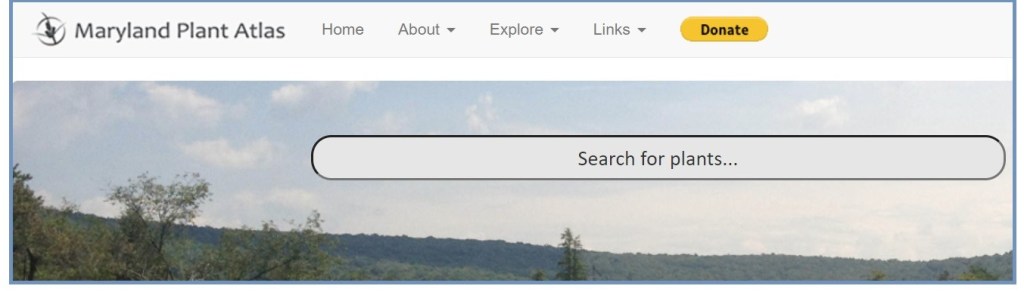
The Atlas is online and easy to use.
Each plant species in the flora has a species page containing information about whether the species is native or non-native (including invasive species), distribution, sources of records, and photographic images.
To find a species, the user simply types in either the scientific or common name for a plant on the home page of the Atlas.
How would “Maryland native” be used in practice?
The city council and administration would agree that “native” means “native to Maryland.”
It would be a burden to revise the municipal code in order to include a definition of “native trees.” To avoid this, the council and administration should agree that “native trees” means “trees native to Maryland, as defined by the Maryland Plant Atlas,” as in paragraphs such as the following one from the tree ordinance (emphasis added by FONTT):
12.12.010 Legislative findings and purpose.
The Council of the City of Takoma Park hereby finds that:…
B. The purpose of this chapter is to promote a diverse, resilient, sustainable urban forest through shared community and individual stewardship of existing trees and the planting of new trees with a focus on native trees and desirable trees that are adaptable to the impacts of climate change;
—-Takoma Park Municipal Code, Chapter 12.12: Urban Forest
The Takoma Park Approved Tree Species List would indicate which species are Maryland natives.
The Takoma Park Approved Tree Species List identifies trees species that may be planted with city funding or under the requirements for a tree removal permit. The list should clearly identify the species that are Maryland natives.
FONTT has compiled an Excel spreadsheet listing all species presently on the Tree Species List and identifies Maryland natives according to the Maryland Plant Atlas. We can provide this spreadsheet to the city to enable it to easily revise the Tree Species List to indicate Maryland native trees.
The following figure illustrates how the first three columns in the Tree Species List could clearly and prominently communicate this information:

The annual Urban Forest Management Report would report on Maryland native trees planted.
The tree ordinance requires an annual report to the City Council on the number and percentage of native trees planted by the city and under the provisions of the tree ordinance.
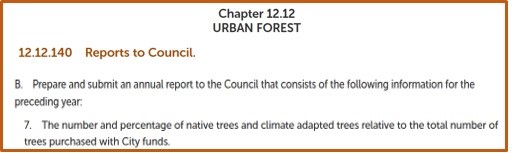
Future reports should include statistics on both the number and percentage of Maryland native trees that have been planted with city funds or under the provisions of the tree ordinance.
For example, these statistics for 2023 are 242 native species trees planted out of a total 303 trees planted, or 80% native species trees.
Note: These statistics do not include the replacement trees planted under the tree ordinance’s permitting procedures because the species of those trees were not given in the 2023 UFM report.
 Friends of Native Trees in Takoma