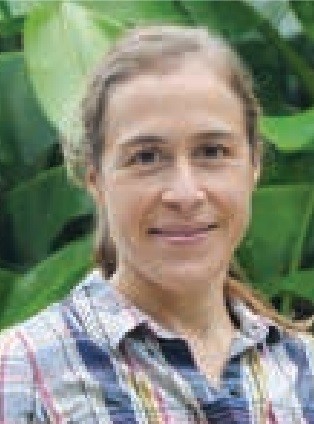
FONTT will present Anna Miche John with an achievement award for her initiative, skill, artistry, and accomplishments in improving native habit in Takoma Park. The award ceremony will be on Maryland Arbor Day, April 1, 2026, at the beginning of the City Council meeting (7:30 PM).
Find several options for watching the event live here.
Afterward, view a recording of the meeting here.
Read on to learn about Anna’s work in creating a native tree arboretum for Takoma Park.
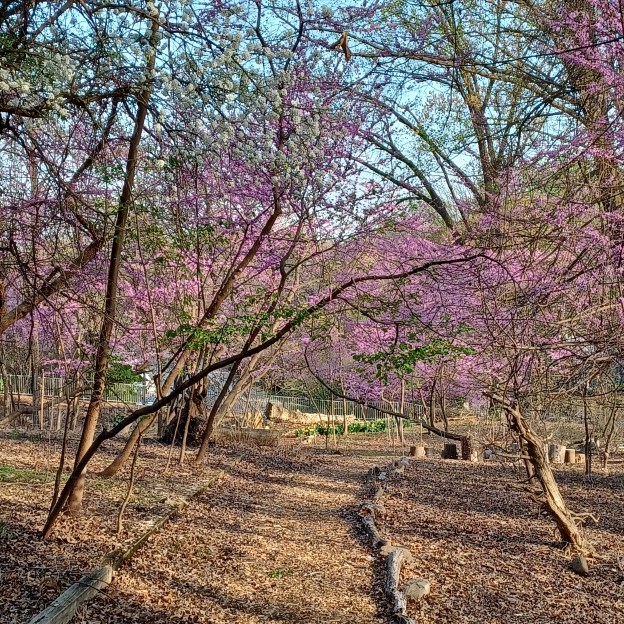
Stuart Armstrong Park has undergone a remarkable transformation.
Not so long ago, this sloping site next to Takoma Park Elementary School was a thicket of invasive shrubs and vines, littered with discarded bottles and cans.
But Anna Mische John, Vegetation Manager for the City of Takoma Park, saw its potential. When John discussed her plan to convert the park into an arboretum of native trees and shrubs at a city event last June, she noted that the site already featured southern red oak, American holly and redbud.
John’s plan began at the end of 2023. Contractors removed a thick grove of tree-size Asian bush honeysuckles along the fence bordering the school.
In spring 2024, contractors returned to remove or kill the remaining invasives, including porcelainberry and English ivy. Later three large and ailing trees were felled. Together with the bush honeysuckles, these were used to make wood chips for paths.
Last fall, contractors and volunteers planted two dozen saplings.

To walk through the park now is a delight. Mature trees formerly obscured by curtains of vines take center stage and sport identification labels.
Two massive southern red oaks rise from the entrance at Philadelphia and Holly Avenues. A line of American hollies invites the visitor further uphill. A witch-hazel’s golden blooms were readily visible in November.

Along the upper path, lined by naturally fallen boughs, one can admire a newly planted red maple tree in the northeast corner and a grove-to-be of sassafras saplings, in cages, in the southeast corner. Nearby, a circle of stumps the right height for seating elementary students completes the rustic vibe.
A lower path takes a visitor past young American hophornbeams and fringetrees. Cages protecting recently planted American persimmon, blackjack oak, downy serviceberry, and shagbark hickory dot the park. More plantings—perennials and sedges—will take place later this year.
You can learn more about these trees in FONTT’s native tree guide.
–Meg Voorhes
 Friends of Native Trees in Takoma