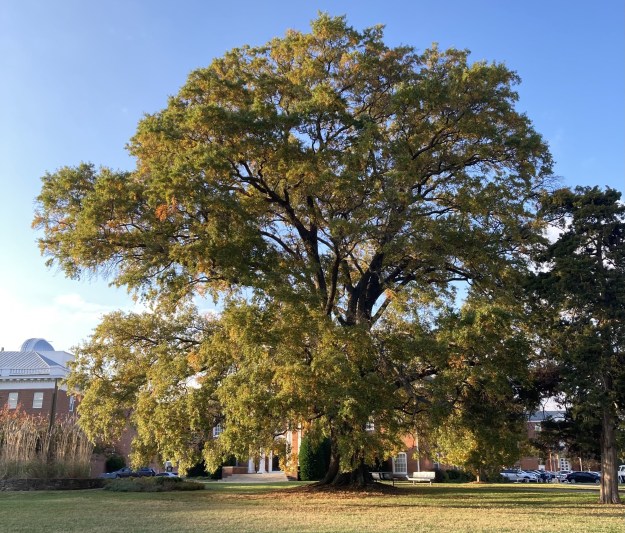
Creating habitat in our yards can help address the loss of biodiversity occurring in our area and across the planet.
Biodiversity loss and climate change are twin threats to the planet’s environment and must be addressed together. This is the main message from a joint scientific report issued in 2021 by the intergovernmental scientific panels charged respectively with climate change (IPCC) and biodiversity and ecosystem services (IPBES).
Ecosystems depend on their biodiversity to function, sustain themselves, and deliver the services upon which life depends. “When we allow one species to die, we erase the web of relationships it maintained in life, with consequences that scientists seldom understand,” wrote the noted biologist, Edmund O. Wilson, “… we break many threads, and change the ecosystem in ways still impossible to understand.”
Urbanization is the most obvious factor behind the loss of biodiversity in our area, although climate change plays a role, too. Maryland is the fifth most densely populated state in the nation at 625 people per square mile. In Montgomery County, the population density is 2,543. Buildings, roads, and pavement have dramatically reduced the unbuilt land available for native habitat.
It is not feasible for rural Maryland alone to provide sufficient space for biodiversity. Conventional agricultural practices, such as mono-cropping and pesticide use, limit the land in rural areas where native species can live. As a result, in rural areas as in urban areas, the land available to native species is often fragmented and small. Isolation of species in small land parcels reduces their population sizes. A population downswing can easily take a species below the critical population size necessary for survival.
In part, the solution lies in using our urban unbuilt spaces more wisely by planting them with native trees and other native plants. Native flora, even in urban areas, provides habitat for native fauna. The more unbuilt space we can plant with native plants, the more we connect otherwise fragmented green spaces
Native species foster biodiversity because they have vital interactions with so many other native species in an ecosystem. Species native to a specific area have evolved over millennia into an interrelated ecological system, an ecosystem. Countless evolutionary interactions among diverse native species underpin how well an ecosystem functions and can sustain itself.
For example, the larvae of the tawny emperor butterfly and the hackberry butterfly only eat the foliage of hackberry trees. The tawny emperor eats older foliage while the hackberry butterfly eats new leaves. If there are no or few hackberry trees, these two butterfly species will no longer be available to contribute to the food web and pollination in our area.
Non-native species have many fewer or no such species interactions. Non-native species are like cogs that don’t mesh well with the other gears in the system.
Planting native species in urban areas will provide a cascade of benefits to biodiversity throughout our region. We will not see Maryland native black bears moving into Takoma Park, but we can provide habitat that maintains regional insect populations, which supply a surprising portion of a black bear’s diet. We can also give food and shelter to exhausted Central American migratory birds, who land here each year in desperate need of a caterpillar supper.
 Friends of Native Trees in Takoma