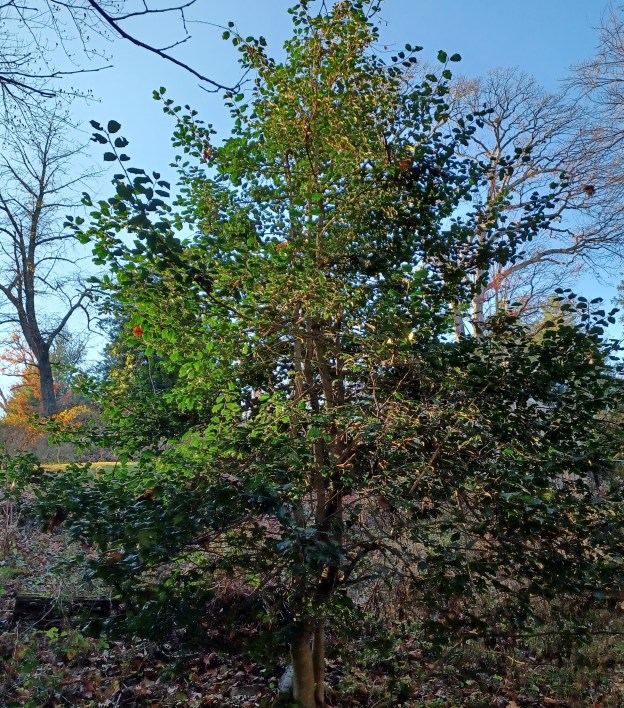
You don’t need to celebrate Christmas to venerate the American holly tree, Ilex opaca, also known as Christmas holly. Its evergreen branches console our inner pagan as the days grow short and dark. The red berries that appear in autumn on female plants—if male plants are nearby—pop against the dark green foliage and persist through the winter if not devoured by birds.
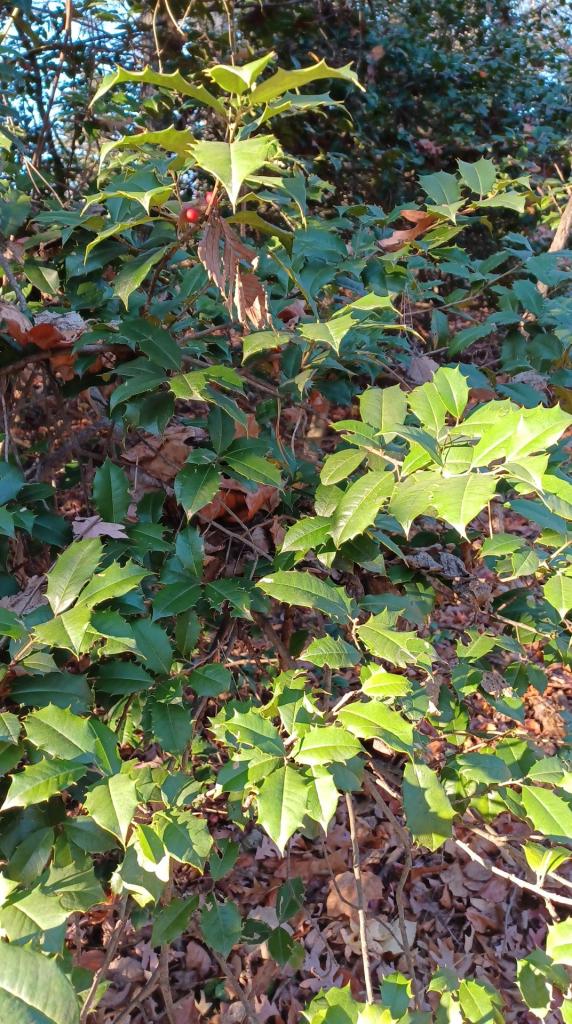
While the berries are poisonous to humans, cats, and dogs, they are a welcome sight to hungry robins, mockingbirds, catbirds, and mourning doves that overwinter or return in early spring.
Cape Cod and the Massachusetts shore represent the northernmost point of American holly’s range, which hugs the northeastern coast before broadening into a swath that extends west to Ohio and south to the Florida panhandle and eastern Texas.
The species name “opaca” refers to the opaque or dull sheen of its leaves, which helps to distinguish it from non-native English holly. American holly leaves may be less lustrous than their English cousins’, but their spines are also less severe. You can brush against American holly without undue concern should you choose to deck your halls with its boughs.
Ilex opaca is the only native holly that becomes a tree at maturity, rather than topping out as a shrub. The height of its shaggy, pyramidal form varies with location. In moist woods in the middle of its range, it can grow as tall as 50 feet, but in Maryland it generally does not exceed 30. It prefers sandy or loamy soils, and it can do well both in full sun and in the shade cast by taller trees. Takoma Park neighbors can find many lovely specimens of American holly in Dorothy’s Woods, off Woodland Ave.
–Meg Voorhes
 Friends of Native Trees in Takoma
Lovely! sharon
“Where flowers bloom, so does hope.” – Lady Bird Johnson
>
LikeLike
What a beautiful description of one of our loveliest native trees. Thank you!
LikeLike
Good first blog! Thanks! I will wander over to Dorothy’s Woods and try to see these hollies. Maybe we can point out the location of other examples as well.
LikeLike